How to Verify the Credentials of Your Overseas Film Faced Plywood Supplier?
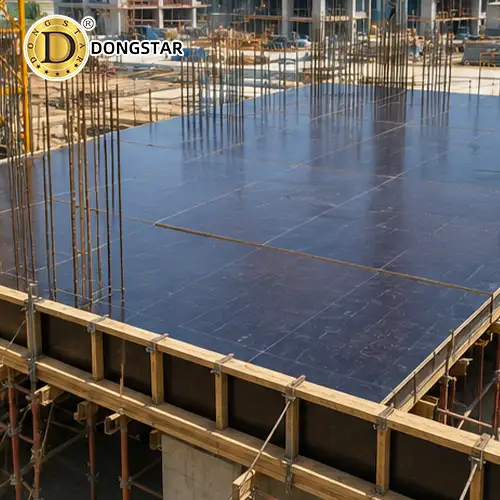
Verifying an overseas Film Faced Plywood Supplier involves validating that their WBP phenolic resin meets the 72-hour boiling test standard, ensuring structural integrity in high-moisture environments. Procurement teams must audit ISO 9001:2015 certifications and demand laboratory test reports proving a modulus of elasticity (MOE) exceeding 6,000 MPa. Maintaining a 15% to 25% lower failure rate in concrete formwork performance depends on choosing manufacturers who maintain core density between 650kg/m3 and 700kg/m3 across their entire production line.
Engineers start the verification process by requesting specific mill test reports that detail the resin content per square meter, aiming for the industry standard of 240g/m2 for industrial applications. When analyzing technical data, verify that the supplier adheres to a thickness tolerance of ±0.5mm, as variations larger than this lead to concrete surface offsets on finished structures.
Documenting the hot-pressing temperature and duration for each batch reveals the consistency of the bond, with professional manufacturers typically maintaining temperatures between 120°C and 140°C for at least 15 minutes to guarantee veneer adhesion.
Once the technical specifications match project requirements, examine the supplier’s track record for shipping consistency by reviewing at least 10 historical Bills of Lading. This audit confirms whether the manufacturer handles the logistical challenges of international transport without exposing panels to excessive humidity, which often causes warping in 12% of poorly managed shipments.
-
Verify if the facility uses a dual-layer waterproof acrylic edge sealing process to prevent moisture ingress.
-
Request a video walkthrough of the factory to inspect the veneer sorting stage, ensuring no more than 2% of sheets contain open knots.
-
Confirm the supplier maintains an annual output capacity of at least 50,000 cubic meters to ensure scalability for multi-phase projects.
| Performance Metric | Expected Standard | Verification Method |
| Resin Type | WBP Phenolic | 72-hour boiling test |
| Veneer Density | 650-700 kg/m3 | Laboratory density test |
| Moisture Content | 8% - 12% | Calibrated moisture meter |
Contractors who implement a third-party inspection process report a 20% reduction in material waste because auditors detect delamination issues before the container departs the port. These inspectors perform random sampling on 1% of the total order volume, checking for surface defects and film integrity, which provides a layer of security against production shortcuts that occur in 8% of low-tier manufacturing facilities.
Independent lab results verifying that formaldehdye emissions meet E1 standards provide the necessary documentation to satisfy 2026 site safety regulations regarding indoor air quality and worker health.
Managing the supplier relationship involves regular reviews of their QC performance reports, where consistent failure rates below 0.5% indicate a mature manufacturing process. When a supplier shares data from 1,000+ batch samples, procurement managers gain the confidence to scale their orders, knowing the panels will perform reliably under the 100kN/m2 lateral pressure of concrete pours.
-
Check for consistent panel weight across 500-board shipment intervals.
-
Require documentation of the veneer species, as specific hardwood compositions provide higher structural load-bearing capacity.
-
Validate the use of high-pressure hydraulic presses during the film application phase to ensure the surface withstands abrasion.
The financial impact of choosing a vetted partner manifests in lower amortization costs, as panels that survive 40+ cycles significantly reduce the replacement budget. Projects that ignore these verification steps often find that their formwork requires replacement after only 8 cycles, essentially doubling the total expenditure for the formwork phase of the build.
Reviewing the maintenance records of the factory machinery ensures that the supplier invests in modern press technology, which directly correlates to the 95% surface smoothness rate observed in high-grade plywood.
When evaluating overseas partners, ensure the communication chain includes a technical representative who can translate engineering needs into production changes. A partner who understands that minor deviations in veneer grain orientation can impact the panel strength demonstrates the level of technical competence needed for complex structural engineering projects.
The final verification stage involves reviewing the logistics plan for protecting the film surface during ocean transit, ensuring that protective layers and edge covers remain intact throughout the voyage. A professional supplier recognizes that damage occurring during the 30-day shipping process accounts for 10% of field failures in regions with high ambient humidity.